


February 2026 - Week 2 Edition
A Capsule Market Summary for January 2026
We’re a little later than usual with our one-month market summary but that gives us time and space to point out that – once again – the metals have rallied strongly after their sharp decline on Friday, January 30, and once again, our advice to “buy on dips” paid off, just as it did last October and last December.
Despite the sudden decline in metals, especially silver, both metals ended January with gains that strongly outperformed all of the major stock market indexes. Silver rose 11.6% in January and gold was up nearly 9%. Although the one-day decline on January 30 was sharp, so was the previous rise. Gold merely retreated to its mid-January price and then it soared back above $5,000 in short order.
Once again, our advice to “buy on dips” is paying off with a rise from $4,400 gold on February 2 to $5,050 a week later. Silver’s low was $68.71 on February 5th, followed by a quick rise back to $81.78.
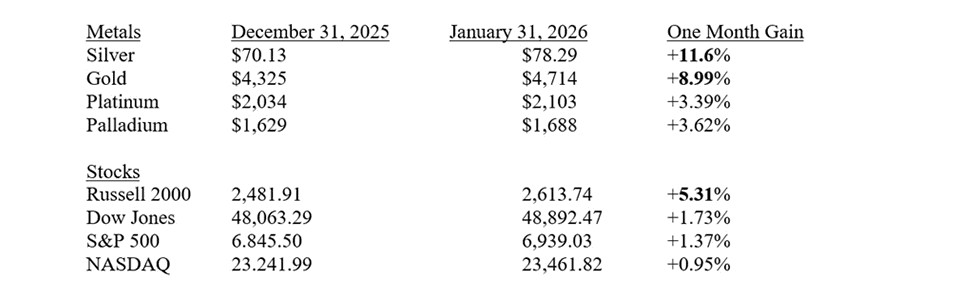
The press is making a big story about the rise of the Dow Jones Industrial Average above 50,000 but the Dow was alone in rising last week, with the NASDAQ composite falling almost 2% and the S&P 500 slightly down. That’s important because NASDAQ and the S&P 500 are much better indicators of the performance of the whole market, rather than the 30-stock Dow, which covers only 30 blue-chip stocks that are sometimes removed and replaced by other stocks if they underperform.
We’re pleased to report that another major bank has revised its gold projection higher. UBS (originally the Union Bank of Switzerland) forecasted gold will end 2026 around $5,900/oz. In making that prediction, the Bank’s analysts wrote, “We believe that strong performances from industrial and precious metals have scope to continue, and we anticipate commodities will play a more prominent role in portfolios in 2026, with returns driven by supply-demand imbalances, geopolitical risks, and long-term trends.”
Last week, we noted that J.P. Morgan Chase projected $6,300 gold in 2026. In our earlier long-term forecasts, we made the case for $7,000 gold in 2026 and $10,000 by 2029 …
Louis Navellier Joins Us in Predicting $10,000 Gold by 2029
We got there first, predicting $10,000 gold by the end of the decade but it’s encouraging to report that the superb stock market advisor Louis Navellier agrees with us. Although he promotes stocks more than gold bullion itself, his portfolios currently contain 20 gold mining shares, since he predicts great gains in the yellow metal over the next four years. In his most recent Market Mail, published on February 10th, he compares gold to the six leading currency alternatives and sees “no alternative” to gold among currencies.
Here’s a portion of his article, with a capsule summary of the currency alternatives:
“The recent consolidation in gold and silver prices is what I call a ‘pause that refreshes.’ But if you look at the supply/demand fundamentals, gold has a lot of room to recover. For instance, if you try to buy gold bullion coins or bars, especially at Costco, they are frequently sold out of available supply, with a long waiting list. Also, silver and gold have separate fundamentals. Silver is much more sensitive to industrial demand, while gold is primarily a precious metal alternative currency in the foreign exchange market.
“Here are the major alternatives to gold, arranged in reverse order of merit, from the worst to the best:
Alternative #1: Cryptocurrencies. Due to poor performance in 2025 and accelerating losses in 2026, more cryptocurrency investors are apparently migrating to gold due to its superior performance, with a track record measured in centuries. Furthermore, many crypto ETFs have had hideous bid/ask spreads.
Alternative #2: The Chinese yuan. China has suffered hideous deflation since May 2022, and its interest rates are now below Japan’s. Due to shrinking households from the “one baby” policy enacted decades ago, China’s domestic economy is in a terminal decline…. The only way China can stop a deflationary spiral is via a currency devaluation, which it did before it joined the World Trade Organization (WTO).
Alternative #3: The Japanese yen. Japan is also losing households, which is making paying off its government debt next to impossible. Japan’s new Prime Minister is spending more money, which in turn is hindering the Bank of Japan, which is expected to increasingly print money via quantitative easing to make ends meet. The net result will continue to be ultralow interest rates and a depreciating Japanese yen.
Alternative #4: The British pound. British Prime Minister Keir Starmer chased wealthy Britons out of the country to Guernsey, Jersey and other offshore tax shelters, where wealthy British have traditionally created asset protection trusts. As a result, there is a government budget shortfall, so middle-class Britons have to pay higher taxes due to the capital flight Starmer has sparked. The Bank of England has no other choice than to slash rates and enact quantitative easing, which will undermine the value of the pound.
Alternative #5: The euro. Brussels has become a bureaucratic octopus, systematically destroying many industries, like the farming and auto sectors. Furthermore, Brussels is no longer just a monetary and trade union. Instead, the EU leaders in Brussels have evolved into a political machine, meddling in elections Long-term, the euro will erode in value due to poor GDP growth and infighting among its 27 nations.
Alternative #6: The U.S. dollar. Although the U.S. has substantial government debt per capita (approximately $110,000), America also has substantial assets, such as natural gas, crude oil, gold and other commodities, as well as plenty of valuable land owned by the federal government serving as excellent collateral. The U.S. GDP growth is now approaching a 5% annual rate … so I expect the dollar to rally, because the U.S. tends to have higher interest rates than other alternative countries.
“Even so, gold is stronger than the U.S. dollar, which is likely to be the strongest currency in the years ahead. Since U.S. interest rates are anticipated to decline in the next few years, gold will likely become a more popular investment, so $10,000 per ounce gold is a realistic target price by the end of the decade!”
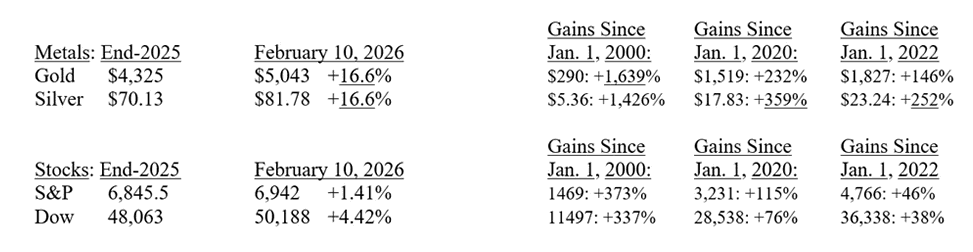
During the first 10 days of February, gold traded back above $5,000 and rose 7% from $4,714 at the end of January. In the same period, silver is up 3.7% while the best stock market index, the S&P 500, is essentially flat (up only 0.04%) and the tech-heavy NASDAQ Composite is down more than 1.5%.
Metals Market Report Archive >
Important Disclosure Notification: All statements, opinions, pricing, and ideas herein are believed to be reliable, truthful and accurate to the best of the Publisher's knowledge at this time. They are not guaranteed in any way by anybody and are subject to change over time. The Publisher disclaims and is not liable for any claims or losses which may be incurred by third parties while relying on information published herein. Individuals should not look at this publication as giving finance or investment advice or information for their individual suitability. All readers are advised to independently verify all representations made herein or by its representatives for your individual suitability before making your investment or collecting decisions. Arbitration: This company strives to handle customer complaint issues directly with customer in an expeditious manner. In the event an amicable resolution cannot be reached, you agree to accept binding arbitration. Any dispute, controversy, claim or disagreement arising out of or relating to transactions between you and this company shall be resolved by binding arbitration pursuant to the Federal Arbitration Act and conducted in Beaumont, Jefferson County, Texas. It is understood that the parties waive any right to a jury trial. Judgment upon the award rendered by the Arbitrator may be entered in any court having jurisdiction thereof. Reproduction or quotation of this newsletter is prohibited without written permission of the Publisher.