


February 2026 - Week 1 Edition
Breaking Down The Recent Dip In Gold And Silver Prices
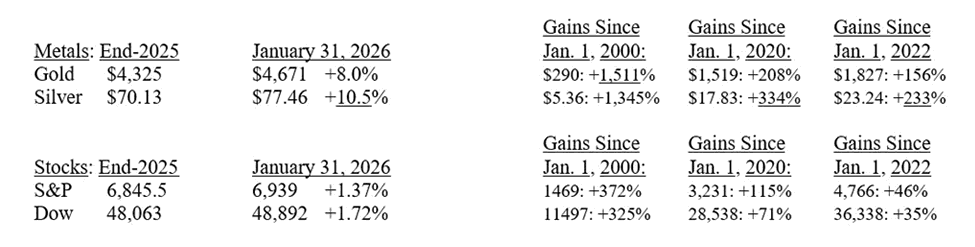
On Thursday morning, January 29, gold and silver were soaring to new record highs, as gold topped $5,600 at one point and silver momentarily hit $120. By the next day, gold fell to $4,700 and closed the week at $4,670. Silver delivered a more powerful surge – then fell – reaching a low of $74 before closing at $77.50 - down 35%. This caused many to recall gold and silver’s 1979-80 surge and retreat. That “bubble” was based on high inflation, a Russian invasion of Afghanistan and a failed attempt to corner the silver market. On Friday, there was no market corner, high inflation or Iran invasion.
What happened last Friday was (1) President Donald Trump nominated a strong currency “fundamentalist” to run the Fed, causing some to fear the dollar would rally and gold would fall. Then came (2) the latest Producer Price Index rise of 0.5% (a 6% annual rate), higher than expected, which seemed to cause the “weak gold hands” to assume there would be no more rate cuts, so gold fell on news of higher inflation! As we have shown many times here, this is weak historical reasoning, as gold rose on rising rates and high inflation in the past. The news on Friday gave fickle investors the reasons they were looking for to take some profits.
We know our history here. Just three months ago, something similar happened. From October 20 to 30, 2025, gold fell 10%, from $4,360 to $3,920 and silver declined more (-13%), falling from $53 to $46 in late October and from $78 to $70 after Christmas. We advised investors to “buy on dips,” and that was good advice, as gold and silver are still well above their October 30 lows of $3,920 and $46 per ounce.
What Now? Is Investing In Rare Coins The Right Move?
What we have seen is that typically after gold or silver makes a significant rise and then pulls back some, as they have recently, that in the nine to 18 months following, rare coins tend to follow suit and usually maintain their values when the gold and silver markets are volatile. That was especially true when rare coins reached previously unattained highs following the historic bullion and rare-coin market increases from 1976 to 1980 and from 1986 to 1990. Why this occurred in the past is that most gold and silver bullion buyers purchased their bullion from rare coin dealers and are introduced to the numismatic market. About one-in-eight of those bullion buyers become rare coin buyers in our company’s history. This greatly expands the demand for rare coins, resulting in increased prices for select coins in the rare coin market. The easiest coins for rare coin dealers to initially interest bullion buyers in are often rare gold coins that have a significant component of gold value in them, like select $20 Liberty and $25 Gold Eagle gold coins. Many buyers then move on to buying rarer gold coins that strike their fancy. Mark Twain is reported to have said, “History doesn’t repeat itself but it often rhymes.” Based on current market activity, I think Mark Twain will be right again as it pertains to the rare gold coin market following a major move in the bullion markets.
Adding to the potential demand for rare gold coins in the future is all of the new, exciting semiquincentennial 250th Anniversary coinage being issued in 2026 by the U.S. Mint. The 1776 Bicentennial coinage helped drive the biggest, rare coin bull market in history from 1976 to 1980.
Further helping the rare gold coin market in the future is the current mass melting of many common $20 and $10 gold coins in grades up to MS64. In the future, this will assist better-date coins that weren’t melted as the population and availability decrease.
The bottom line, in my opinion, is the future rare gold coin market for expertly selected coins in our 20/20 program by your Team Mike (Fuljenz) experts, which includes myself, Stacey Stegall and Trent Roberts, looks pretty good for the rest of this decade and balances out the volatility of bullion as seen recently.
Soaring Silver Prices Cause Backlog of Silver Redemptions at Dealers
Silver is surprising even its most bullish champions, leaping from $32 per ounce in May 2025 to $108 as of Friday, January 23’s close and $115 by Wednesday, January 28, more than tripling over eight months before its major drop to $77.50 on Friday, January 30th. This is similar to the rapid explosion in silver prices from late 1979 to early 1980, when silver rose from $15 to $50 in short order but that was in a time of super-high inflation and silver’s big leap was based on the Hunt brothers trying to corner the silver market on major U.S. commodity exchanges. Then rules were changed and silver took a similar retreat in price.
We have explained this rise in recent months as being due to a combination of investment demand, industrial demand and a sudden embargo on about two-thirds of China’s refined silver – a part of the ongoing trade war between China and the United States. This has caused a severe supply shortage for 5 years, which is now partly being met, in part, by average Americans bringing their silverware, silver plates, some random “junk silver” coins and other silver items to America’s coin shops and dealers for redemption at prices of $100 per ounce or more. It is causing a severe backlog of orders at the limited number of smelters that reclaim silver. They must measure, weigh and redeem their silver value for the army of new customers expecting a bonanza for their stored silver objects at home. This uncommon rush to buy and sell bullion has also caused many dealers to delay orders and payments, as so many extra boxes of product take extra days to process.
We have also heard increased reports of counterfeit items, often mixed with pure silver items, causing dealers to hesitate before buying large loads of unauthenticated silver items. Some of these silver dealers are not trained to spot fake silverware or coins. This is our way of warning you against being ripped off by low-ball bids at local dealers, or of expecting some immediate payment for your “junk” silver. Also, be wary of buying online, as most ads offering silver below the spot price are offering counterfeits. In an effort to continue warning unsuspecting buyers about the pitfalls of finding things that are too good to be true, one of my team members just tested this a few weeks ago with “silver” bars and coins he found on Facebook. Although these silver items incorrectly bore the name of a legitimate company, when we tested the items, we were able to determine they were all worthless fakes. Only buy and sell with trusted national award-winning dealers and keep on buying on the dips.
Major Business Leaders and Wall Street Gurus Champion Gold
As we have often commented here, most established Wall Street investment bankers tend to “chase” the gold price up, predicting micro-moves that that are reached almost before the ink is dry on their writings.
Several business leaders predicted major gold moves a year or more ago and are still bullish. Here are three:
Ray Dalio founded Bridgewater Associates in 1975 and remains the Chief Investment Officer of that hedge fund 50 years later. He has become a multi-billionaire in the process and has written several books on geopolitics and investing. He has long called gold an “alternative money” and a hedge against fiat currency devaluation, geopolitical and internal political risks. He cites high debt and ongoing inflationary pressures to recommend a 5% to 15% gold allocation to protect the purchasing power in a portfolio. He previously said 5% to 10% is enough but lately he has suggested up to a 15% core position in gold.
Dalio considers gold as “fundamental money” which serves as a safe haven when Wall Street’s bread-and-butter assets (stocks and bonds) either fall or tread water, especially if the Treasury “monetizes” our high debt load. In saying this, he compares the current economic conditions to the 1970s, when he launched his fund, when gold and silver soared while bonds and stocks lost any “real” (after inflation) returns.
Jeffrey Gundlach is the reigning “Bond King” on Wall Street but he has been a strong advocate for the “anti-bond” values of gold, calling gold a “real asset.” A year ago, he predicted gold would reach $4,000 when that price was considered outlandishly high. He cited strong central bank buying and repudiation of most paper currencies. At the time, he suggested a higher gold portfolio allocation than Dalio, up to 25%, as a portfolio balancer, but as gold rose in price, he trimmed that down to a 10% to 15% recommendation.
Elon Musk has long supported gold (and crypto) as alternative currencies and while running DOGE last year, he also led the fight to audit the U.S. gold reserves at Fort Knox, preferably with a live video feed to help document his efforts.
For personal portfolios, Musk advocates gold as a hedge against inflation and a way to diversify out of the declining value of the U.S. dollar. He doesn’t settle for gold ETFs. He advocates owning physical gold assets, noting that gold bullion “cannot go bankrupt” as financial institutions and other companies can do. He calls real gold assets a “liquid cash alternative” in this challenging economic environment.
J.P Morgan Chase is now projecting gold to reach $6,300 an ounce by the end of 2026.
Welcome to the wonderful world of Gold, Ray, Jeff, Elon and J.P Morgan Chase. Other billionaires will be joining you soon.
Metals Market Report Archive >
Important Disclosure Notification: All statements, opinions, pricing, and ideas herein are believed to be reliable, truthful and accurate to the best of the Publisher's knowledge at this time. They are not guaranteed in any way by anybody and are subject to change over time. The Publisher disclaims and is not liable for any claims or losses which may be incurred by third parties while relying on information published herein. Individuals should not look at this publication as giving finance or investment advice or information for their individual suitability. All readers are advised to independently verify all representations made herein or by its representatives for your individual suitability before making your investment or collecting decisions. Arbitration: This company strives to handle customer complaint issues directly with customer in an expeditious manner. In the event an amicable resolution cannot be reached, you agree to accept binding arbitration. Any dispute, controversy, claim or disagreement arising out of or relating to transactions between you and this company shall be resolved by binding arbitration pursuant to the Federal Arbitration Act and conducted in Beaumont, Jefferson County, Texas. It is understood that the parties waive any right to a jury trial. Judgment upon the award rendered by the Arbitrator may be entered in any court having jurisdiction thereof. Reproduction or quotation of this newsletter is prohibited without written permission of the Publisher.