


The Michael Fuljenz Metals Market Report: October 2012, Week 3 Edition
Why Gold is Down Temporarily
Gold is down due to a pair of reports by the International Monetary Fund (IMF) and World Bank released last week, saying that the world economy is slowing down. The resulting assumption is that China and India will not be able to afford to buy more gold, since slower Asian growth will reduce disposable income in those countries. That is not entirely true (as we'll explain below) but traders have jumped on the momentum bandwagon once again, thinking they can trade in and out of gold for short-term moves.
China and India are "Slowing" But still Growing Very Fast -
Also: Their Renewed Currency Strength Favors Gold Buying
The world's stock and commodity markets both fell last week after the International Monetary Fund (IMF) came out with their latest edition of "World Economic Outlook," in which the IMF lowered their global GDP growth forecast for 2012 to 3.3%, from 3.5% and 3.8% in previous reports. Turning to the all-important Asian leaders, China and India, the IMF says that China will grow by "only" 7.8% this year (down from 9% to 10% in previous years), while India will only grow 4.9% (and Japan, 2.2%) in 2012.
Then, the World Bank chimed in, saying that the East Asian region will grow "just" 7.2% this year, down from a previous forecast of 7.6%. (The East Asian group is led by China but also includes fast-growing smaller economies like Cambodia, Indonesia, Laos, Malaysia, Mongolia, The Philippines, Thailand and Vietnam.) Obviously, 7.6% is still a phenomenal annual rate of growth, the envy of the rest of the world.
In addition, the Indian rupee has strengthened by about 5% in the last month, giving India renewed gold-buying power just in time for its wedding season and gold-buying holidays. India's renewed currency strength has caused gold demand to hit a 5-month high there, according to UBS, a leading Swiss bank. The exchange rate is now back to where it was in April, before a sudden weakness struck last summer.
The Indian wedding season (late September through January) is now in full bloom. Gold plays a central role in Indian weddings. The bride and her family are laden down with what looks like several pounds of jewelry. In addition, gold coins and medallions are considered the most desirable gifts for newlyweds.
In the midst of the wedding season, India also celebrates Diwali in November. Called the "Festival of Lights," Diwali is India's most important holiday of the year, like our Christmas season. It is celebrated around the world by "overseas Hindus" in every major nation. The first day of Diwali is considered an auspicious date for gold-buying. Now, with a stronger currency and a still-growing economy, the gold markets in China and India - the world's two largest markets for gold demand - should continue strong.
Scottish Bank: Double Your Gold Holdings
Gary Dugan, a senior executive at Coutts, the private banking arm of Britain's Royal Bank of Scotland, advises investors to double up on their gold holdings as world currencies lose value.
"What's happening in precious metals is that they are becoming more mainstream," Dugan said, adding that ten years ago investors rarely held any gold in their portfolios. "Some of the clients ask where gold prices are going, and I say don't even think about prices. It's a store of value."
Dugan said gold's appeal to investors is likely to rise as the world economy grows more volatile and unstable after decades of generally steady and dependable growth. Dugan said there seems to be no quick fix for the structural weaknesses of the U.S. and European economies.
"We are going back to normality, and the normality is that precious metals are the core part of your portfolio," he added. "One client literally took delivery in a van, because he did not trust any bank to store his gold for him," Dugan said.
Newmont CEO: Weak Currencies Brighten Gold's Future
"Currency is going to dictate the day for gold, and that says gold is going to up," says Newmont Mining CEO Richard O'Brien.
O'Brien said currently gold trades more like a currency than a commodity. O'Brien told a recent mining conference that investment is the largest growing component of the gold market, currently comprising about 40% of the demand for gold. As more currencies weaken, such as the U.S. dollar and the Euro, O'Brien suggests the current bull market for gold will continue well into the future.
Five Signs That Gold Coin Demand Grew in August and September and Should Continue Growing
- Major dealers' gold coin inventories have shrunk dramatically.
- Major dealers report more million dollar days than in any other months in 2012.
- Major dealers are reporting more large gold coin orders coming from buyers they haven't heard from in years and from new buyers!
- National television and radio ads for rare gold coins are increasing, especially for $10 and $20 denomination gold coins.
- We have recently seen more European buying than selling of U.S. gold coins. Traditionally, Europeans sell more than they buy. This reversal hasn't happened in a long time. It is very bullish for many $10 and $20 gold pieces that are typically imported from Europe and are becoming tougher to find and more expensive to buy.
1910 Philadelphia Mint $10 Indian Gold Eagle MS63
For many years, I have liked the historic $10 Indian gold coin. I even wrote an NLG award-winning book about the series, titled "Indian Gold Coins of the 20th Century." Currently I believe it is a historically opportune time to acquire better date $10 Indians in better grades. This week's graph shows how multiple coins totaling $10,000 in scarce MS63 1910 $10 gold eagles would have increased in value in the last 4 months that I have purchased them. The graph reflects the price gains of actual coins I have been fortunate to buy, showing an increase from $10,000 to $11,100 in just 4 months. This market now reminds me of the old oil filter commercial that said, "You can pay me now or pay me a lot more later."
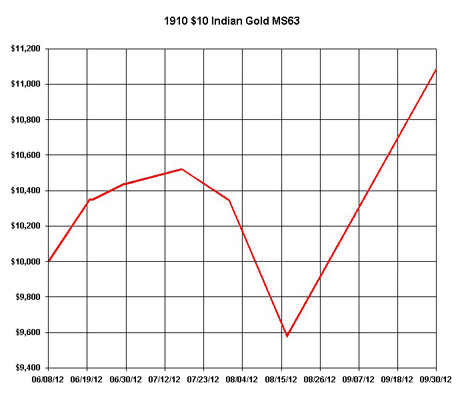
I recommend at least a 5-10 year hold period on rare coin purchases but this graph shows impressive gains can occur during a short time span. We all know that past performance of this one coin does not guarantee future performance for all coins. Many experts recommend buying better dates and grades because of often better long-term performance for much of the past 100 years. Read my book to learn about famous successful long-term gold coin set builders like Louis Eliasberg. His set building provided him long-term benefits of diversification and significant premiums were later realized.
Metals Market Report Archive >
Important Disclosure Notification: All statements, opinions, pricing, and ideas herein are believed to be reliable, truthful and accurate to the best of the Publisher's knowledge at this time. They are not guaranteed in any way by anybody and are subject to change over time. The Publisher disclaims and is not liable for any claims or losses which may be incurred by third parties while relying on information published herein. Individuals should not look at this publication as giving finance or investment advice or information for their individual suitability. All readers are advised to independently verify all representations made herein or by its representatives for your individual suitability before making your investment or collecting decisions. Arbitration: This company strives to handle customer complaint issues directly with customer in an expeditious manner. In the event an amicable resolution cannot be reached, you agree to accept binding arbitration. Any dispute, controversy, claim or disagreement arising out of or relating to transactions between you and this company shall be resolved by binding arbitration pursuant to the Federal Arbitration Act and conducted in Beaumont, Jefferson County, Texas. It is understood that the parties waive any right to a jury trial. Judgment upon the award rendered by the Arbitrator may be entered in any court having jurisdiction thereof. Reproduction or quotation of this newsletter is prohibited without written permission of the Publisher.