


The Michael Fuljenz Metals Market Report: October 2012, Week 2 Edition
Gold hit a new 2012 (and 12-month) high of $1792 on Thursday, October 4, then corrected to $1782 on Friday, due to a stronger-than-expected September jobs report. That bit of optimism may be misguided (see below), so gold could continue its usual fourth-quarter rise later this month. The price of gold is now well above where it was at this time last year ($1652) and at the start of 2012 ($1574).
Gold Traders the Most Bullish in Three Weeks
Gold traders are feeling pretty frisky these days, according to a Bloomberg survey. Gold traders are the most bullish in three weeks as investors' bullion holdings expanded to a record after central banks pledged to do more to spur economic growth. Of the 32 analysts surveyed by Bloomberg, 20 of them (nearly two-thirds) expect gold prices to rise next week. Nine traders were bearish, and three were neutral. The general trader optimism on gold may be predicated on the fact that investors are holding the most metal ever through gold-backed exchange-traded products after buying 85.4 metric tons last month, the most since July 2011. Hedge funds' bets on a rally are the biggest in seven months, according to U.S. Commodity Futures Trading Commission data. "More and more people are going to anticipate inflation in the future because of quantitative easing and the amount of debt we've got in the system," said Frederique Dubrion, the Geneva-based president and chief investment officer of Blue Star Advisors SA, which manages metals and energy assets. "We can print whatever amount of money we need, but you can't print gold. It's nobody's liability, it's a hard currency."
Though silver may benefit from the central bank stimulus initiatives, it faces some challenges that may hold it back as gold surges. "Silver is more exposed to industrial demand, so if the global economy continues to slow down, this will become a headwind for the metal," said Elliott Orsillo, co-founder and portfolio manager at Season Investments.
Why Do I Discuss Metals in a Coin Company Newsletter?
Gold prices affect the rare coin market both directly (for bullion coins) and indirectly (for numismatic coins). The impact is more immediate if gold is a major component of the gold coin's market value. For example, a common circulated $20 Liberty gold coin will be more affected initially than a gem uncirculated $3 gold piece. The more rare and desirable a coin is, typically the less effect modest gold moves will have on its price. However, rising gold prices often result in more customers from advertisements for coin dealers. Customers also often tend to buy more coins when gold rises than when it falls. During a number of historical bull markets, there has been a significant secondary impact of a strong metals market on many rare gold coins.
Conversely, declining gold prices over time can reduce advertisement response by new customers and may be a factor in later rare coin price declines. The economy can also play a part in whether customers buy as often and spend as much on rare coins. There are no absolutes or guarantees here, just valuable lessons, and opportunities, from history to consider.
Five Signs That Gold Coin Demand Grew in August and September and Should Continue Growing
- Major dealers' gold coin inventories have shrunk dramatically.
- Major dealers report more million dollar days than in any other months in 2012.
- Major dealers are reporting more large gold coin orders coming from buyers they haven't heard from in years.
- National television and radio ads for rare gold coins are increasing, especially for $10 and $20 denomination gold coins.
- We have recently seen more European buying than selling of U.S. gold coins. Traditionally, Europeans sell more than they buy. This reversal hasn't happened in a long time. It is very bullish for many $10 and $20 gold pieces that are typically imported from Europe and are becoming tougher to find and more expensive to buy.
Iran's Currency is Collapsing
Last week, there were protests in Iran's currency exchange district as police in riot gear attacked Iranian citizens trying to change their money. After many Iranians tried to switch their money into hard currency without success, rioting began. According to Reuters, Iran arrested or shut down all the money changers. President Mahmoud Ahmadinejad blamed Western sanctions for the plunging rial, but his own hoarding of gold and dollars is what really caused the shortage. The Iranian currency (the rial) fell by 50% last week. Starving your people while hoarding all the wealth is not a winning political or stability formula.
1910 Philadelphia Mint $10 Indian Gold Eagle MS63
For many years, I have liked the historic $10 Indian gold coin. I even wrote an NLG award-winning book about the series, titled "Indian Gold Coins of the 20th Century." Currently I believe it is a historically opportune time to acquire better date $10 Indians in better grades. This week's graph shows how multiple coins totaling $10,000 in scarce MS63 1910 $10 gold eagles would have increased in value in the last 4 months that I have purchased them. The graph reflects the price gains of actual coins I have been fortunate to buy, showing an increase from $10,000 to $11,100 in just 4 months. This market now reminds me of the old oil filter commercial that said, "You can pay me now or pay me a lot more later."
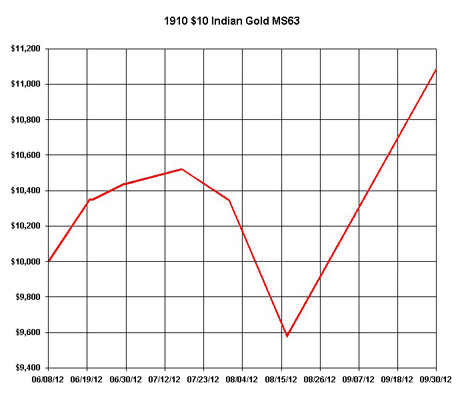
I recommend at least a 5-10 year hold period on rare coin purchases but this graph shows impressive gains can occur during a short time span. We all know that past performance of this one coin does not guarantee future performance for all coins. Many experts recommend buying better dates and grades because of often better long-term performance for much of the past 100 years. Read my book to learn about famous successful long-term gold coin set builders like Louis Eliasberg. His set building provided him long-term benefits of diversification and significant premiums were later realized.
The ECB Joins other Central Banks in Printing More Paper Money
Iran isn't the only country inflating its currency away. Iran is merely pushing the "fast forward" button, while Europe and America are slowly eroding their currency. Last week, Europe learned that its euro-zone unemployment rate reached a record high 11.4% in August. The number of unemployed grew by another 34,000 to reach 18.2 million jobless workers, all looking for work. Spain's official jobless rate surpassed 25%, while its youth (under 25) rate reached over 50% (52.9%). Two of Europe's three largest economies (i.e., Italy and France) also had unemployment rates over 10% in the latest reading, so the European Central Bank (ECB) finally decided to act, by printing more money for the "common good." The ECB is now the last major central bank domino to fall after the Swiss National Bank, Bank of England, Bank of Japan and U.S. Federal Reserve have already instituted expansive monetary policies. Last week, Fed Chairman Ben Bernanke defended his new QE3 policies by saying they are "just the same" as QE1 and QE2, rather than facing the fact that the government has become addicted to his easy money solutions for funding each year's new trillion-dollar debts. As all major central banks continue to inflate, this will virtually guarantee that gold will continue rising.
The Jobs Situation is Not as Positive as it May Seem
Gold corrected on Friday due to a strong jobs report, on the assumption that there is less need for future monetary easing, hence less monetary inflation and less demand for gold, with a recovering economy and a shrinking jobless rate. But, Friday's job report masked a series of negative numbers wrapped in a single positive headline, a 7.8% unemployment rate, down from August's 8.1% and the first drop below 8% since President Obama was sworn into office in January 2009. One more monthly jobs report will come out before the election (on the Friday before the Tuesday vote). That headline number could be positive enough to boost the President's chances for re-election, but the underlying statistics are not so positive, implying that the Federal Reserve will need to continue priming the pump with fiat money, which will be positive for gold.
Metals Market Report Archive >
Important Disclosure Notification: All statements, opinions, pricing, and ideas herein are believed to be reliable, truthful and accurate to the best of the Publisher's knowledge at this time. They are not guaranteed in any way by anybody and are subject to change over time. The Publisher disclaims and is not liable for any claims or losses which may be incurred by third parties while relying on information published herein. Individuals should not look at this publication as giving finance or investment advice or information for their individual suitability. All readers are advised to independently verify all representations made herein or by its representatives for your individual suitability before making your investment or collecting decisions. Arbitration: This company strives to handle customer complaint issues directly with customer in an expeditious manner. In the event an amicable resolution cannot be reached, you agree to accept binding arbitration. Any dispute, controversy, claim or disagreement arising out of or relating to transactions between you and this company shall be resolved by binding arbitration pursuant to the Federal Arbitration Act and conducted in Beaumont, Jefferson County, Texas. It is understood that the parties waive any right to a jury trial. Judgment upon the award rendered by the Arbitrator may be entered in any court having jurisdiction thereof. Reproduction or quotation of this newsletter is prohibited without written permission of the Publisher.