


The Michael Fuljenz Metals Market Report: September 2012, Week 1 Edition
Gold soared Friday on news that the Federal Reserve may ease money supply before the elections. In his widely anticipated talk at Jackson Hole, Wyoming, last Friday, Fed Chairman Ben Bernanke said the U.S. job situation is a "grave concern" and "tepid" economic growth is "far from satisfactory." Because of this anemic growth, Bernanke said the Fed will "provide additional policy accommodation as needed." Gold shot up about $30 on that news, while silver rose even faster, climbing back over $32 per ounce. CNBC just announced that gold is approaching an all-time high in terms of the euro.
The Indian Gold Coin That Will Become "The Face of Numismatics"
One important Indian gold coin from the early 20th century could someday become "the Face of Numismatics" in the 21st century. It's a gold coin so valuable, worth over 15 million dollars, and so beautiful that in the future you'll probably see it on almost every national news story about rare coins, and you'll see replicas advertised on TV. What's the gold coin? In this Metals Market Report I'll tell you about it, and why I and many other numismatic experts believe someday it will be widely considered the most important and valuable coin an individual can own -- and how it will affect you and your Indian gold coin investments. (Hint: I'm currently working on a feature article related to this unique Indian gold coin. It's expected to be published in a national magazine by the end of the year.)
The Face of Numismatics:
1907 Indian Head Double Eagle (J-1905, gold)
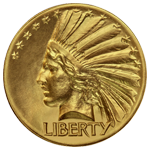
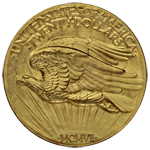
- A pattern coin is one that was struck at the Philadelphia Mint (with a few exceptions) for the purpose of testing a new design concept or unusual metal. A pattern differs in some ways from normal circulating coins. Patterns were not monetized and thus were not legal to spend.
- J. Hewitt Judd, M.D. was the author of the definitive guide book on United States pattern coins. Pattern coins were assigned Judd numbers like J-1905. This coin is unique and is the most valuable coin extant today (worth over $15 million).
- J-1905, formerly listed as J-1776, was the same size and weight as a $20 gold coin.
- Its obverse design is Lady Liberty's left-facing head wearing an Indian war bonnet. This is essentially the same final portrait used on the $10 Indian gold coin.
- Below the Indian Head on the obverse is displayed the inscription LIBERTY, not the date of issue, which appeared on the approved $10 Indian obverse.
- The reverse design is virtually the same as the new $20 coin made for commerce in 1907 - a breathtaking eagle in flight, inspired by the reverse of the flying eagle cent.
- Saint-Gaudens moved the Roman Numerals date to the reverse, engraved atop the sun at the base of the coin.
- J-1906 is identical to J-1905 except it is technically a trial strike made of lead. It resides in the American Numismatic Society collection.
- President Theodore Roosevelt considered U.S. coinage to be sterile, dull and unworthy of a great nation. He admired Saint-Gaudens' renowned medallic work and deemed Saint- Gaudens well suited to carry out Roosevelt's vision for U.S. coins, inspired by the glorious high relief coinage of ancient Greece.
- Frustrated with the obstructive responses of the U.S. Mint's Chief Sculptor-Engraver Charles Barber, President Theodore Roosevelt consulted Tiffany's and Gorham's, the two great New York silversmiths and jewelers of 1906, for expertise in die manufacturing related to striking coinage in high relief.
- J-1905 was Augustus Saint-Gaudens' initial recommendation for the design of the new double eagle. The obverse portrait ended up on the new $10 gold, not the $20, but the reverse was used for the new $20.
- Augustus Saint-Gaudens died of cancer, August 3, 1907, after J-1905 was struck, but before the final approved new $20 double eagle was released into circulation.
- In 1981, the Indian Head double eagle (J-1905) set a price record for any coin produced by the U.S. Mint, bringing $475,000.00 at the official convention auction of the American Numismatic Association.
- The last time J-1905 traded hands was at a private sale in 1985 to a "major Northeastern collector" who was an executive in a high-tech field. It sold for what was described as a "mid six-figure price." It still resides in that spectacular collection, which includes numerous other extremely rare and valuable coins and medallic works of Augustus Saint-Gaudens.
- While many other rarities have broken the million-dollar barrier since 1996, the Indian Head double eagle has remained unsold since 1985. A reported $15 million offer for the Indian Head double eagle was rejected. In most guides, it is currently listed as the most valuable coin by far. The highest price paid at auction to date for a U.S. coin was $7.59 million for a 1933 Saint-Gaudens $20 in 2002, about one half the value of J-1905.
- This ultimate coin could be transformed overnight into something even more special: The Face of American Numismatics. Unquestionably, its price would be so sensational that news of its sale would be periodically featured on front pages of newspapers, big and small, across the country. It would be given prominent play on newscasts and trumpeted by headlines on major internet websites. I believe its sale would serve to continually increase interest and demand for all Indian gold coins and particularly the $10 Indian, which the Indian Head double eagle's obverse so closely resembles.
- The eagle found on the reverse of the Bela Lyon Pratt $2 ½ and $5 Indian gold coins is strikingly similar to the eagle on the reverse of the Augustus Saint-Gaudens $10 Indian. It is believed to be a form of tribute by Pratt to his recently deceased mentor Saint-Gaudens. This is another reason collectors of Augustus Saint-Gaudens works often revere and collect these Indian gold coins too.
America and Europe May Soon be forced to Fight Recession with "Easy Money"
The Fed's Open Market Committee (FOMC) meets next week. Ben Bernanke's speech last Friday opened the door to more monetary easing. Perhaps the Fed will announce a form of "quantitative easing" at their September 12 meeting, or they may wait until after the November elections, but the likelihood of more easing has already lifted gold and silver higher. European central bankers may follow suit. Last week, the President of the European Central Bank (ECB), Mario Draghi suddenly canceled his plans to attend the Fed's Jackson Hole meeting, due to his "heavy workload." The head of the ECB traditionally attends this event, so his sudden cancelation raised fears that there could be a crisis brewing in Europe.
The unemployment rate in Spain is over 24% and the jobless rate in all of the European Union hit 11.3% in July. Inflation is generally lower in Europe than the U.S., but Europe's inflation rose to a 2.6% annual rate in August, higher than America's rate and higher than economists expected. The next ECB monthly meeting happens this Thursday, September 6. In July, ECB President Draghi said he would do "whatever it takes" to rescue the euro, so the ECB could launch its own form of quantitative easing, which could weaken the euro, fuel euro-zone inflation fears and drive many more Europeans into the gold market.
Gold Isn't Alone - Many Other Commodities Are Also Rising Sharply
Speaking of inflation, we're seeing a rapid rise in both energy and food prices, in addition to gold. Last week, the World Bank said that global food prices surged 10% in July, led by corn prices rising 25% and soybeans up 17%. The ongoing U.S. drought is part of the problem, but the old Soviet bloc is also suffering from a drought, as the wheat crop is sharply down in Kazakhstan, Russia and the Ukraine.
Oil and gasoline prices are also rising. AAA said that gasoline prices just set a record high for a Labor Day weekend, partly because of Mideast tensions but also because Hurricane Isaac shut down Gulf rigs and refineries in Louisiana, since Hurricane Isaac hovered over Louisiana for several days last week.
Precious Metals Had a Great Summer, with More Gains to Come
Gold peaked during this week last year, hitting $1895 in London and nearly $1920 in New York. The press never seems to tire of telling us that gold was a "bubble" last September. They're wrong, of course. "Bubble" markets usually fall 50% or more from their peak to their pre-boom lows, but gold fell by only 20%, never slipping below $1500 in the last year. In the last three months, gold and silver are up strongly:
Metals May 31 August 31 3-Month GainGold $1558 $1694 8.73%
Silver $28.10 $32.37 15.20%
Platinum $1405 $1553 10.53%
While the press points to a "bubble" last September, long-time gold market observers know that the 2011 rise and fall was just another typical (and almost predictable) correction in a long-term bull market. You don't have to go back to the 1970s to find a parallel. Something similar happened in 2007-09, when gold rose faster and declined further than it did in the last year. Savvy investors, of course, buy on such dips.
Since January 1, 2012, gold is up 7.6% for the year-to-date, apparently on its way toward its 12th straight rising year. As of September 4, 2012, gold is slightly ahead of the Dow Jones Industrial Average for the year, while silver has doubled the Dow's gain for the year so far, with the "golden season" just beginning!
Metals Market Report Archive >
Important Disclosure Notification: All statements, opinions, pricing, and ideas herein are believed to be reliable, truthful and accurate to the best of the Publisher's knowledge at this time. They are not guaranteed in any way by anybody and are subject to change over time. The Publisher disclaims and is not liable for any claims or losses which may be incurred by third parties while relying on information published herein. Individuals should not look at this publication as giving finance or investment advice or information for their individual suitability. All readers are advised to independently verify all representations made herein or by its representatives for your individual suitability before making your investment or collecting decisions. Arbitration: This company strives to handle customer complaint issues directly with customer in an expeditious manner. In the event an amicable resolution cannot be reached, you agree to accept binding arbitration. Any dispute, controversy, claim or disagreement arising out of or relating to transactions between you and this company shall be resolved by binding arbitration pursuant to the Federal Arbitration Act and conducted in Beaumont, Jefferson County, Texas. It is understood that the parties waive any right to a jury trial. Judgment upon the award rendered by the Arbitrator may be entered in any court having jurisdiction thereof. Reproduction or quotation of this newsletter is prohibited without written permission of the Publisher.