


The Michael Fuljenz Metals Market Report: May 2012, Week 5 Edition
Gold fell $30 on Wednesday, the same day the Dow fell 200 points in the morning, before recovering. On Friday, gold gained $16 in New York to limit the damage for the week. Over the long weekend, we reached $1585, but then gold settled back to $1574 late Monday, dead even for the weekend and the year-to-date. The major cause for gold's decline was a surge in the dollar to the euro. The continued collapse of Europe pushed the euro below $1.25 last week, down from $1.48 last summer and $1.33 in early May.
- Gold 52 weeks ago (May 31, 2011): $1536.50
- Gold's average price during 2012: $1665.12
- Gold's London Low for 2012: $1537 on May 16
- Gold's London High for 2012: $1788 on February 29
Last Week In Metals: Gold fell $20 (-1.2%), silver fell $0.20 (-0.8%), platinum fell $33 (-2.2%) and the Dow rose 0.7%.
Rising Demand for $10 Indian Gold Coins Should Boost Prices Soon
I recently learned about a very large purchase of better-date high-mint-state $10 Indian gold coins by a major company. This is one of many companies that have shown interest in the $10 gold Indians, which were designed by the same sculptor that designed the $20 Saint-Gaudens Double Eagle. Over 100 years ago, U.S. President Theodore Roosevelt chartered the aging dean of American sculptors, Augustus Saint-Gaudens, to design these two elegant U.S. gold coins, the $10 Indian and $20 Double Eagle. As author of the leading reference work on the Indian series of gold coins, I am aware when other companies order multiple copies of my book, presumably to help promote sales of these classic gold coins containing almost a half-ounce of gold. We also know from past experience that a buying frenzy in these $10 Indians is good for the overall gold coin market as investors matriculate from the Indians to buy other series of classic gold coins.
Periodically, I will post graphs of how various coins have performed over time. For many years, I have liked the historic $10 Indian gold coin. I even wrote an NLG award-winning book about the series, titled "Indian Gold Coins of the 20th Century." Currently I believe it is a historically opportune time to acquire better date $10 Indians in better grades. This week's graph shows how multiple coins totaling $10,000 in scarce MS-62 1910-S $10 gold eagles would have increased in the six years that I have purchased them. The graph reflects the price gains of actual coins I have been fortunate to buy over the years, showing an increase from $10,000 to $23,000, over two times, in six years.
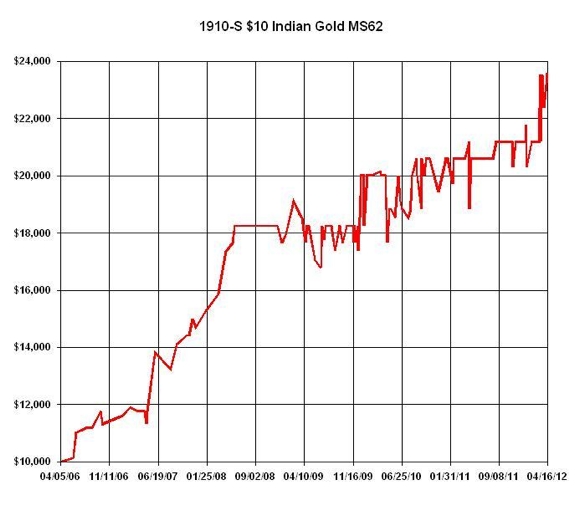
As you can see, there are price dips along the way. That's why I recommend at least a 5-10 year hold period on rare coin purchases. In the shorter time frames in this graph, price performance can lag for a few years, only to be followed by impressive gains. We all know that past performance of one coin does not guarantee future performance for all coins, but we can still learn many lessons from history. Many experts recommend buying better dates and grades because of often better long term performance for much of the past 100 years. Read my book to learn about famous very successful long-term gold coin buyers like Louis Eliasberg.
Gold's Next Upward Move Will Likely Come From a New Round of Global Monetary "Stimulus" (Printing Money)
The biggest emerging trend last week was the decline in manufacturing around the world. The level of manufacturing is measured by the Purchasing Managers Index (PMI) in various countries, calculated by a company called Markit, along with the Institute for Supply Management (ISM). The theory behind such surveys is that manufacturing is a byproduct of orders in the pipeline for raw materials and supplies. Any number above 50 signals expansion, while numbers below 50 represent retraction, the start of a recession.
Last week, Markit reported the euro-zone PMI falling to a 35-month low of 45.9 in May. Even "red hot" China has seen its PMI fall for seven straight months, finally dipping below 50 in April (49.3) and May (48.7), signaling a major slowdown there. In America, durable goods orders fell 3.7% in March and fell 0.6% (excluding transportation orders) in May. So we may be entering a worldwide recession this year.
In addition, the U.S. Congressional Budget Office (CBO) warned America last Tuesday that we could suffer a major recession here next year if we don't avoid the "fiscal cliff" of automatic spending cuts and tax increases starting next January 1, 2013. Some people call this date our "Tax Armageddon" date, more dangerous than the Mayan calendar's purported "end of the world" date on December 21, 2012.
Facing this much economic contraction, it is likely that the central banks of the United States, Europe and Asia will "loosen" monetary policy, which means printing money and debasing their currency. This is almost certain to push up the price of gold in terms of every currency that warms up the printing presses.
Central bankers are now more expansive. Consider the fact that the European Central Bank (ECB) is now headed by an inflationary Italian banker, Mario Draghi, and the International Monetary Fund (IMF) is led by a French woman, Christine Lagarde, who just called on the British to print more money! Also, Greece is likely to resign from the EU, while voters in Europe have thrown out any politician calling for austerity.
In America, our Federal Reserve Chairman, Ben Bernanke, fears deflation but is not very worried about inflation. The central bankers in Asia are also inflationary. Chinese Premier Wen Jiabao has just sent an inflationary message to his bankers, saying that they should quit worrying about inflation and "give more priority to growth." Gold investors have been patient during the dollar's rise and gold's fall, but our patience will probably be rewarded as gold rises due to lots more printing press money and less financial austerity later in the year.
Precious metals analyst Jeffery Nichols said last week that this new wave of monetary accommodation by the Fed, the ECB, other European central banks, the People's Bank of China (PBOC), the Reserve Bank of India and others could cause "the biggest bail-out of all time." He sees the possibility of a fall to $1520 gold in the short term, but added, "I believe we will see a reversal of gold's fortunes and new all-time highs, if not this year then certainly in 2013." Moreover, he adds, "the now decade-long advance in the metal's price could last another five to 10 years, given the global economic challenges that lie ahead."
Metals Market Report Archive >
Important Disclosure Notification: All statements, opinions, pricing, and ideas herein are believed to be reliable, truthful and accurate to the best of the Publisher's knowledge at this time. They are not guaranteed in any way by anybody and are subject to change over time. The Publisher disclaims and is not liable for any claims or losses which may be incurred by third parties while relying on information published herein. Individuals should not look at this publication as giving finance or investment advice or information for their individual suitability. All readers are advised to independently verify all representations made herein or by its representatives for your individual suitability before making your investment or collecting decisions. Arbitration: This company strives to handle customer complaint issues directly with customer in an expeditious manner. In the event an amicable resolution cannot be reached, you agree to accept binding arbitration. Any dispute, controversy, claim or disagreement arising out of or relating to transactions between you and this company shall be resolved by binding arbitration pursuant to the Federal Arbitration Act and conducted in Beaumont, Jefferson County, Texas. It is understood that the parties waive any right to a jury trial. Judgment upon the award rendered by the Arbitrator may be entered in any court having jurisdiction thereof. Reproduction or quotation of this newsletter is prohibited without written permission of the Publisher.