


The Michael Fuljenz Metals Market Report: February 2013, Week 3 Edition
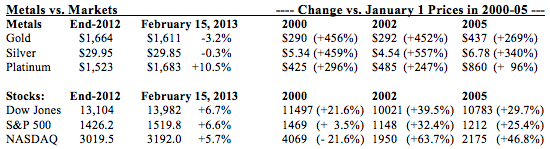
Last Week: Gold fell $57 (-3.4%), silver fell $1.63 (-5.2%), platinum fell $32 (-1.9%) and the Dow stocks fell 0.1%.
Gold fell below $1,600 on Friday for the first time since last August, but it rallied back to $1,610 by the end of the day. The decline began on Thursday, when the Associated Press misleadingly headlined "4% lower gold demand" (by ounces) in 2012 vs. 2011. However, gold sales were up in dollar terms and the details of the overall World Gold Council report were positive. (I got interviewed about this by KTRH a major Houston talk radio station Thursday and Friday morning). Gold's decline was amplified when some major hedge funds announced (via required SEC filings) on the same day that they had sold gold ETF shares in the fourth quarter of 2012, however investments in gold ETF's actually rose 51% in 2012. Then, computerized selling from "stop loss" price points (i.e., automatic orders to "sell below $1625" or $1615) pushed gold down: The trend-followers panicked. Also, investors were tantalized by stocks, since the Dow Jones and S&P 500 indexes were approaching new all-time highs, luring investors into stocks. Still, many countries working to weaken their currencies remain a bullish factor for gold.
- Gold 52 weeks ago (February 20, 2012): $1,733
- Gold's price at the start of 2013: $1,664
- Gold's London Low for 2013: $1,607 on February 15
- Gold's London High for 2013: $1,694 on January 2
WGC: Central Bank Gold Buying At 48-Year High
Central banks stuffed their vaults with the most gold in nearly half a century last year, according to the World Gold Council (WGC). Banks bought 145 tons in the fourth quarter, the eighth straight quarter that central banks were net buyers of gold. For the year, official government purchases of gold totaled 534.6 tons, an increase of 17% over 2011 and the most in 48 years, since 1964. Gold finished the year with a gain for the 12th consecutive year, making this the longest-running bull run in at least nine decades, according to WGC.
"We think that the current rate of net central bank purchasing, driven by emerging countries, is likely to continue to be very strong," Marcus Grubb, managing director of investment research at the council. "This is very much due to a desire to diversify away from over-reliance from the dollar and the euro."
Russia's Putin Turns Black Gold Into Yellow Gold
Russia is now the worlds' top oil producer, and it is strategically trading its black gold for yellow gold. Russia's central bank is the world's top official purchaser of gold, buying up 570 tons of the precious metal over the last decade, one-fourth more than runner-up China.
"The more gold a country has, the more sovereignty it will have if there's a cataclysm with the dollar, the euro, the pound or any other reserve currency," said Evgeny Fedorov, a lawmaker for President Vladimir Putin's United Russia party in the lower house of parliament. Putin is credited with making the call to buy gold for Russia's foreign exchange vaults as part of a strategy to strengthen the country's defenses against global financial upheavals.
In 1998, Russia defaulted on $40 billion of domestic debt. Putin came to power a year later. In 2005 he instructed the central bank not to "shy away" from gold. "After all, they're called gold and currency reserves for a reason," Putin said, according to a Kremlin transcript. He told the bank to start buying gold.
"Putin's gold strategy fits in with his resource nationalism, statist agenda," said Tim Ash, head of emerging-market research at Standard Bank in London.
10,000-fold Gains For One Coin!
On January 24, 2013, a 1794 Flowing Hair silver dollar graded Specimen-66 by PCGS brought over $10 million at auction. In the late 1800's, when coin collecting started to sweep the nation, these coins were called the "Dollars of our Daddies." It's not too late to make substantial profits and enjoy doing it with select rare coins.
The 1794 Flowing Hair dollar was first sold in the open market in 1945 for $900. Two years later, it sold for $1,250, so you would think the first buyer would be happy, but he gave up 10,000-fold gains by selling "too soon." In the 67 years since 1945, the 1794 silver dollar has gained a total of 11,130-fold, but that does not make any single year a guaranteed gain.
The person who bought this coin in 1984 for $264,000 made the mistake of selling it two years later for 21% less (at $209,000). The lesson is that it seldom pays to sell too soon. That's why we recommend a five-to-ten year hold to our customers. This 1794 dollar is another example of the value of holding historically important rare coins over time. This is why we continue to recommend, and write about, historically important rare coins of high quality for our customers.
1794 Silver Dollar
| Year Sold | Sale Price |
|---|---|
| 1945 | $900 |
| 1947 | $1,250 |
| 1984 | $264,000 |
| 1986 | $209,000 |
| 1988 | $375,000 |
| 1991 | $506,000 |
| 2010 | $7,850,000 |
| 2013 | $10,016,875 |
Metals Market Report Archive >
Important Disclosure Notification: All statements, opinions, pricing, and ideas herein are believed to be reliable, truthful and accurate to the best of the Publisher's knowledge at this time. They are not guaranteed in any way by anybody and are subject to change over time. The Publisher disclaims and is not liable for any claims or losses which may be incurred by third parties while relying on information published herein. Individuals should not look at this publication as giving finance or investment advice or information for their individual suitability. All readers are advised to independently verify all representations made herein or by its representatives for your individual suitability before making your investment or collecting decisions. Arbitration: This company strives to handle customer complaint issues directly with customer in an expeditious manner. In the event an amicable resolution cannot be reached, you agree to accept binding arbitration. Any dispute, controversy, claim or disagreement arising out of or relating to transactions between you and this company shall be resolved by binding arbitration pursuant to the Federal Arbitration Act and conducted in Beaumont, Jefferson County, Texas. It is understood that the parties waive any right to a jury trial. Judgment upon the award rendered by the Arbitrator may be entered in any court having jurisdiction thereof. Reproduction or quotation of this newsletter is prohibited without written permission of the Publisher.